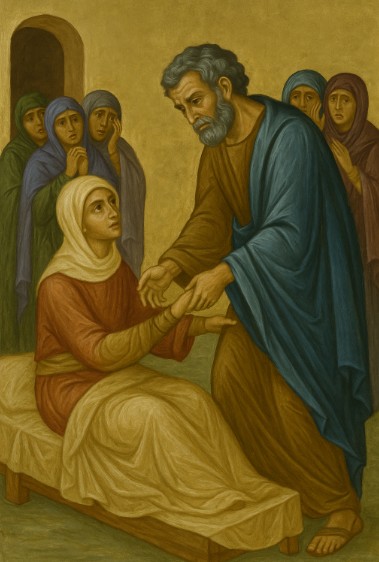
In Acts 9, we encounter Tabitha (also known by her Greek name, Dorcas), a disciple in Joppa renowned for her charitable deeds, particularly making clothing for widows. When she fell ill and died, the community, deeply moved by her loss, sent for Peter, who was in the nearby town of Lydda. Upon his arrival, Peter was taken to the upper room where Tabitha’s body lay, surrounded by grieving widows displaying the garments she had made. After sending everyone out, Peter knelt in prayer and then said, “Tabitha, get up.” She opened her eyes and sat up, and Peter presented her alive to the believers, leading many in Joppa to believe in the Lord .
This miraculous event is not just a testament to Peter’s apostolic authority but also reflects the early Christian community’s deep interconnectedness and the significant roles women played within it. Tabitha’s resurrection underscores the value of her contributions and the impact of her loss on the community. Interestingly, despite the profound nature of her experience, the narrative does not record any words from Tabitha after her revival. This silence parallels other resurrection accounts in the New Testament, such as that of Lazarus, where the resurrected individuals do not share their experiences, perhaps emphasizing the mystery of the divine and the focus on the act of resurrection itself.
The story also invites reflection on the spiritual beliefs of the time, particularly the influence of texts like 1 Enoch on early Christian thought. Scholars like Michael Heiser have explored how concepts from 1 Enoch, such as the Watchers—angelic beings who transgressed divine boundaries—shaped understandings of spiritual warfare and the cosmic battle between good and evil . In this context, Tabitha’s resurrection can be seen as a manifestation of divine power overcoming death and the forces associated with it, reinforcing the early Christian message of hope and the triumph of life through faith.